MPAA Rating: R | Rating: ★★½
Release year: 2019
Genre: Crime, Drama, Superhero Director: Todd Phillips
Earlier this week, filmmaker Martin Scorsese gave his comments on the rise of superhero films, comparing them to theme parks and stating that such works aren’t “the cinema of human beings trying to convey emotional, psychological experiences to another human being.” The publication of said comments in Empire coincides with the critical frenzy surrounding Todd Phillips’ villain origin story, Joker, a film which relies heavily on (read: impersonates) Scorsese’s masterpieces, Taxi Driver and The King of Comedy. But if Joker is a theme park, it’s mostly akin to a grim abandoned sideshow, creepy clowns and all.
At the depraved center of Joker is Joaquin Phoenix as Arthur Fleck, an isolated man with a history of mental illness living in poverty in 1980s Gotham City. Working as a clown, he cares for his mother, Penny (Frances Conroy), with genuine concern, though there’s good evidence that she is not fully living in reality. She’s obsessed with contacting billionaire Thomas Wayne (Brett Cullen) as much as Arthur is obsessed with watching and emulating popular talk show host Murray Franklin (Robert De Niro). Repeatedly beat down in life, both metaphorically and literally, Arthur’s acquisition of a handgun from a co-worker empowers him to fight back against the powers which appear to prevent him from happiness. As the violence escalates, so does Arthur’s self-confidence, culminating in his public transformation into the psychotic clown of Gotham.
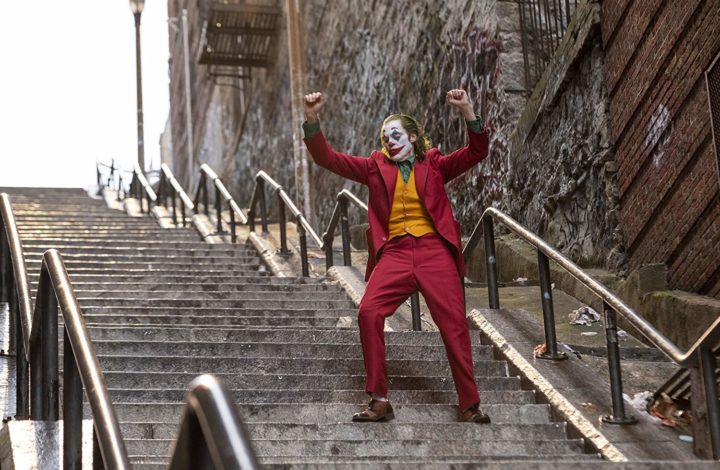
Emaciated and gangly, Phoenix’s performance as Arthur is turned up to 11; he laughs and dances with a disturbing glee in this unhinged and daring portrayal of a man who sometimes seems frighteningly sane in his unsettling antics. Though the characters are similar, this is a far cry from Phoenix’s muted PTSD-laden performance in You Were Never Really Here, a far stronger film which Joker often seems to mimic (particularly the mother-son relationship). In a scene following Arthur’s first murders, Phoenix dances slowly around a decrepit bathroom with a sinister sinuousness, his motions hauntingly calm in the wake of such distressing behavior. While the film strives to make Arthur sympathetic, it also frustratingly draws overt links between mental health and (in a strange plot twist) adoption as possible sources for Arthur’s spiral into violence. (As an adoptee, any time a film script equates “adopted” with “evil” or “broken” it gives me hives.)
The supporting performances from key character actors, such as Shea Whigham and Bill Camp as police detectives investigating Arthur’s crimes, and surprising cameos from Bryan Tyree Henry and Marc Maron, ground the film in an empathetic humanity. Cullen’s Wayne is underwritten, as is a supporting character of a neighbor played by Zazie Beetz (her role sadly serves little purpose in the film apart from Arthur’s fantasies). Phillips borrows so heavily from other films and directors, and my suspension of disbelief was often challenged; a scene at Wayne Manor with a young Bruce Wayne is too unrealistic even in this madcap cinematic vision, and certain actions during the final act drag on unbelievably. Thus, I found Joker‘s strengths to be less about the script and direction, and more in the amazing and textured costumes (Mark Bridges) and makeup (Nicki Ledermann), the incredible haunting score from Hildur Guðnadóttir, and the production design of the gritty garbage-infested Gotham (Mark Friedberg). And again, Phoenix is totally bewitching—even when he’s displaying the worst of human tendencies, you just can’t look away.
If Joker has anything interesting to say about our present culture at large, with its protests of angry anarchists and above-it-all billionaires running for political office, it’s as simplistic as “look at how crazy it is out there.” Indeed, Joker is faux-profound, albeit mostly well-crafted in its pseudo-profundity. It provides no answers nor catharsis, no good explanations nor visions of possibility for a broken world. Arthur and Phillips are simply along for the wild ride, laughing uncontrollably as they go. So it’s an appropriate film for its eponymous antagonist, one of the most popular comic book villains of all time: repellent in its wanton depravity, it’s still maddeningly captivating, and sure to spark strong reactions. Whether those reactions bring out the best in us remains to be seen (I’m not holding my breath) but I imagine we’re all meant to be the punchline.
IMDB Listing: https://www.imdb.com/title/tt7286456/
I respectfully disagree with your opinion that the adoption piece is not important. I am also an adoptee, and I have lived through the trauma. I work with adopted and foster youth. I see every day how adoption and it’s secrets define and mold life. The decline in mental health of an adoptee is so painfully played out in the Joker character. That, with the relentless bullying,fueled his decline into madness.
I hope that the adoption connection is discussed- it’s once again the subject that is so right in your face but people want to ignore, because it’s supposed to be a beautiful thing. You’re “saving” a baby from a horrible life with a birth parent. Obviously not always the case, and the depiction of it in this film is a prime example.
Michelle, my observation about using adoption as a trope to explain someone’s immoral behavior was not dismissing it as “not important” as much as lacking nuance and care. There are films and books which tells adoptees stories with honesty and empathy, and explore the complexity of the situation. “Joker” is not one of those stories; it *uses* adoption—just as it uses depression/anxiety and genuine mental health concerns—as a manipulative tool for excusing or explaining Arthur’s violence. As an adoptee, I find that troubling.
Hello, Dr. Mayward.
I really liked most of what you had to say about this film, and I love to read such a thorough analysis, though I can’t help but think you are reading into it too deeply in some aspects. Joker is one of my favorite DC characters (maybe 2nd), partly because of the unique psychology of the character, and also because there is a simple “rationality” behind his chaos, an objective message broadcasted through twisted madness – in most iterations of Joker (“The Dark Knight,” “The Killing Joke,” and “Gotham” are my favorites). This Joker appears to break that mold. This is one of my favorite movies, because it is simple in and of itself. It’s an interesting, simple, self-contained story of a familiar but still different character and displays a shocking psychological down spiral. Unlike most movies, I would say this film doesn’t have a simple or clear, profound or proverbial overarching theme at its heart. It lets you determine what you take away from little parts of it, not necessarily looking at the film as one big picture. Nearly until the end, Arthur’s motives are largely unclear. It is only near the end when we see the culmination of everything, how twisted he truly has become.
I may be alone in my opinion, but I find it refreshing to watch such a movie that doesn’t shove complexity, details, twists, or moral lessons down your throat (though I do love Christopher Nolan’s films : ), but lets you simply absorb the atmosphere of it.
This may be a messy and long-winded way to say this, but what I mean to say is that I don’t see that “Joker” is trying to make a certain impression or teach anything (good or bad), as your analysis seemed to allude to, such as by making Arthur an adoptee, etc. (not that I can speak from this specific experience).
What are your thoughts?